We have brought a number of updates to streamline the interpretation of your Germline analyses.
Table of contents
Unified Compound Heterozygosity
 We have significantly improved the Compound Heterozygous (CompHet) module to make it faster and more reliable to confirm this type of interpretation. The goal: bring all relevant evidence — short variants and large variants — into a single, coherent view, with less context-switching and AI-based prioritization to surface the most likely candidates first.
-
The CompHet block in the Variant Drawer is now unified across both the Small Variant Viewer and the Large Variant Viewer (LVV).
-
This summary card in the variant drawer now displays VAF, coverage, and quality metrics for quicker assessment, and is pre-filtered to show only DiagAI "CompHet Suspected" variants, keeping the list focused and actionable.
-
Need to dig deeper? Clicking "View in Full Viewer" opens a variant viewer-like browser where you can display all variants on the same gene, apply filter presets, and sort freely. VKB information is visible in this view, though classification must be done from the main viewer.
-
 Finally, the DiagAI "CompHet Suspected" tag has been split into two distinct labels — "CompHet Suspected" and "SV CompHet Suspected" — making it easier to filter and distinguish between short variant and structural variant candidates in the variant table.
Genotype & Inheritance: Cleaner Display
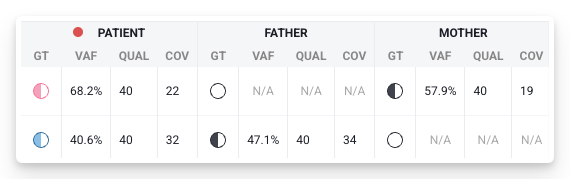
We have reworked the genotype and inheritance display in the Small Variant Viewer to make interpretation more consistent, reliable, and easier to read at a glance.
The genotype icons have been visually refreshed, and inheritance colors are now only displayed when a complete trio (patient, father, and mother) is available, avoiding potentially misleading indications in incomplete family configurations.
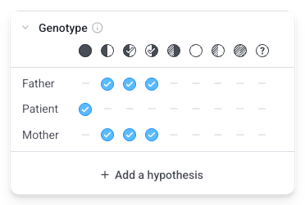
The genotype and inheritance filter panels have also been visually updated — the underlying logic and your existing filter presets remain fully compatible with both old and new analyses.
For sex chromosome inheritance, the platform now uses user-provided sex metadata as the reference, ensuring consistency with your lab's input. Male patients will also benefit from new hemizygous warnings in new analyses.
HPO Filtering: Two Modes
We have updated our HPO filtering logic in the small variant viewer to help you more effectively prioritize variants based on a patient's clinical presentation.
You can now choose between two distinct filtering strategies to better control the size and sensitivity of your gene lists:
- New "Recommended" Mode (formerly Default): This mode calculates an average of the scores of all selected HPOs, then applies a cutoff to optimize sensitivity while keeping gene lists concise.
- New "Union" Mode: You can now use "OR" logic to include every gene that has a score >0 for at least one of your selected HPOs, for a conservative list of all potential associations.
Both of these logics are, as previously, based on our Phenogenius tool. Check out our detailed article for a deep dive into these options.
Pathogenicity Scores Upgrades
 Faster access to key pathogenicity predictors, now more visible and actionable across all variant viewers.
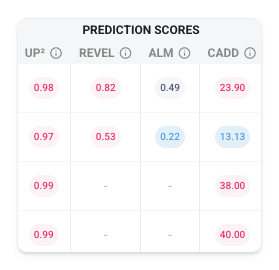
- New Scores Summary Block: In the details drawer, the "Score" tab has been replaced by a new summary block. This layout gathers all key pathogenicity metrics into a single, easy-to-read section.
- Updated Table Display: For more intuitive navigation, variant tables now show numerical values at first glance. The visual scale has also been updated to a red-to-blue gradient to align with common practices.
- Enhanced Sorting & Filtering:
- You can now sort and filter by UP2 score in both viewers.
- We’ve also added CADD and REVEL score filters to both the Small Variant and Large Variant viewers, making it easier to prioritize variants based on your preferred metrics.
GnomAD v4.1 Constraint Metrics
 We have updated our annotation pipeline to include GnomAD v4.1 constraint metrics, bringing richer and more up-to-date gene-level intolerance data to the Small Variant Viewer.
Alongside the existing pLI score, you will now find three new columns in the variant table and detail page, grouped under a "Gene Constraint Scores" header: LOEUF, Z-missense, and Z-synonymous. Each score is displayed with an intuitive intolerant/tolerant badge for quick interpretation.
In particular, LOEUF is a more dynamic and informative measure of LoF intolerance than pLI, offering finer gradation across genes rather than clustering near 0 or 1. A new LOEUF slider filter (ranging from 0 to 2) is also available in the Variant Viewer, making it easy to focus on LoF-intolerant genes.
Additional Improvements
🎯 Restricted Panels for CNVs & SVs: Your panel restrictions are now automatically applied to the Large Variant Viewer, ensuring your view remains focused on the genes selected for your analysis.
📊 GermVar Tertiary - WES kit selection: WES capture kit selection from a list of providers now available for VCF imports in GermVar Tertiary, enabling proper coverage and filtering context for externally processed samples.
🧬 UPD Refinements: We have improved overall sensitivity for Uniparental Disomy (UPD) detection, and resolved an issue in GermVar Tertiary WGS that previously led to an excess of false positive UPD calls.
📚 STR Annotation Database Updated: The database used for STR annotation has been updated to STRchive v2.16.0, a more recent and actively maintained resource covering 74 disease-associated loci, drawing from primary literature, case studies, and major genomic resources including OMIM and GeneReviews.
🗑️ GermVar Tertiary — discarded variants: When running an analysis from VCF, some variants are discarded due to FILTER values or genomic location. GermVar Tertiary and Tertiary Family now provide a new output in the Files tab, Sample_discarded.vcf.gz, which contains the discarded variants as well as the reason for filtering.
🎛️ Filters - Restricted Panel Filter Fix: For users working with restricted panels, the "Gene Panel" filter is now freely accessible, and filter counters in the standard filter bar are now correctly computed when a restricted panel is applied.
⚙️ Filters - Preset Harmonization: SeqOne-provided filter presets for GermVar and GermlineVar have been reviewed and harmonized to ensure they are fully consistent with the metrics available in each workset.